

Webbing Clothes Moths
Webbing Clothes Moth Description
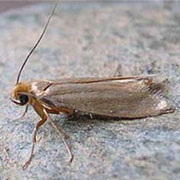
The Webbing Clothes Moth is found more frequently in the USA than the Casemaking Clothes Moth.
Adult moths are 1/2-inch long from wing tip to wing tip; when the wings are folded, the insect is about 1/4-inch long.
The wings and body are buff/golden except for reddish hairs on top of the head. The wings do not have spots.
The antennae are darker than the rest of the body, and the eyes are black.
The larvae are 1/2-inch long when mature. They are small caterpillars that are a clear to creamy-white color with a light brown head capsule.
Webbing Clothes Moth Biology:
The females carefully place their eggs deep in the mesh of the infested fabric by attaching the eggs with a glue they secrete. They are laid in small groups or singly. They are laid among the threads or in the cracks of a suitable food material. Each female lays 40 to 50 eggs which hatch in four days to three weeks. Eggs will hatch more quickly during the summer months. The newly-emerged larvae begin to feed immediately. They often spin silken tunnels or mats, incorporating fragments of the textile being infested and bits of feces into its construction. The larvae molt five to 45 times, depending on conditions, taking from 35 days to two years to finish development. They eventually spin a silken cocoon in which they pupate. Adults live for approximately two weeks. When inspecting any damaged goods, be careful not to confuse the eggs with the excrement from active larvae. These particles are frequently the same color of the fabric the larvae were feeding on.Webbing Clothes Moth Habits:
Webbing clothes moth larvae feed on clothes, carpets, rugs, upholstered furniture, felt, animal hair, and stored wool. They especially like to feed on soiled materials. Adults have nonfunctional mouthparts and do not feed. Adult webbing clothes moths are seldom seen because they void light.
These clothes moths can be found all year long, but they are more numerous during the summer months or heated buildings during the winter months. The Webbing Clothes Moths survive well in humid areas, and seldom occur in very dry areas of the USA.
Webbing Clothes Moth Damage: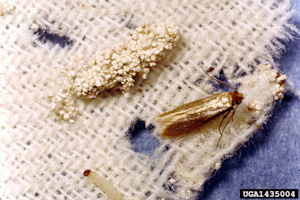
Nap of wool eaten away in spots if lightly damaged; holes completely through the fabric if infestation is extensive. Larvae may be present in the tubes. If fur, hair are cut at the base, exposing the hide and causing loose hair. Fixed silken tubes, sometimes carrying frass(shavings), often the color of the cloth. Fecal pellets are bun-shaped.
Control Treatment Plans-How to Get Rid Of Webbing Clothes Moths
Inspection : Clothes Moths are many times confused with pantry moths. They are close to size and appearance. They may start in a pantry item, but will migrate to closet areas to feed off their preferred food sources, like woolens. Pantry moths will stay in the pantry areas.
Remember that the adults are not the culprits. The larvae cause the damage. Since these moths fly, the siting of an adult does not necessary mean that the damaging larvae are in nearby locations.
Keep in mind, that clothes larvae seek secluded and protected places. A flash light and a small spatula or nail file may be useful to find the larvae.
More Guidelines for Clothes Moth Inspection
The next step is cleaning. Clothes moths, including the Webbing Clothes moth will be first attracted to stains in the fabrics. The larvae are seeking nutrients (Vitamin B) found in these stains, such as sweat and body oils. Dry clean the items like wool, linen, furs and silks and launder the rest. All worn clothing found in an infested area, needs to be cleaned.
Stored Clothing: Stored clothing should be kept in tightly closed containers after cleaning them.
Removal of animal nests : Other sources of clothes moth infestations are animal nests. These nests could be from rodents, birds, wasps or bees. Remove these sources. If there is a rodent infestation, use the trapping method instead of rodent baits. If the dead rodent from a poison bait dies in an inaccessible area, its carcasses can become food sources for these clothes moths and flies.
Traps and Insecticides
The use of traps and insecticides as control methods is the very last step, if necessary. Cleaning and inspection are the most important steps.
Pheromone Traps: Use pheromone traps that are made to lure the webbing clothes moths, such as the Propest Clothes Moth Trap, Safestore X Lure Trap, or the Clothes Moth Alert Trap . These clothes moth traps are not only useful for trapping the male moths, but also monitoring the presense of clothes moths.
Click Here: All the Clothes Moth Traps.
Use Insecticide Aerosols: Use aerosols with crack and crevice tips in secluded areas and the critical areas found after inspection. For larger areas, use insecticide concentrations, such as D-Fense SC. Top recommended aerosols are Bedlam Plus or Temprid Ready Spray.
More Guidelines for Clothes Moth Control
 All Pantry Control Products