
Pantry pest, stored product pest, traps,moths, moth control, beetles,fabric pest,moth infestation, moth traps, pantry pest traps


PANTRYPEST.COM

FABRIC PEST : FURNITURE CARPET BEETLE

Search DIYPC Information Vault

DO IT YOURSELF PEST CONTROL 


TIPS
PRODUCT CATALOG
QUESTIONS/ANSWERS-FAQ'S

Click Image To Go Directly To The Store for Beetle Control Products             

pantry pest, moths, indian meal moths


Free shipping on orders over 25.00 in the U.S.A.
(Except the states of Alaska and Hawaii)


PANTRY PEST:

General information: Pantry pests

Damage by Pantry pests

Recommended Control Measures for Pantry Pests: Moths and Beetles

Confused Flour Beetle and Red Flour Beetles

Cigarette and Drugstore Beetles

Sawtoothed Grain Beetle and Merchant Grain Beetles

Mediterranean Flour Moth

Indian Meal Moth

Identification:  Differences Between Beetles and Moths 

FABRIC PEST:

General information: Fabric pests:Moths and Beetles

Recommended Control Measures for Fabric Pests: Moths and Beetles

Casemaking Clothes Moth

Webbing Clothes Moth

Black Carpet Beetles:

Furniture Carpet Beetles:

Varied Carpet Beetles:


Pest Control Products

 Pest Information


If you have any questions, e-mail us
or call: 1-800-476-3368


Varied Carpet Beetles

Click to enlarge (Actual Size 1/8 inch - 5mm)


The varied carpet beetle is widely distributed in the United States.
Adults are much smaller than the black carpet beetle.
Their body shape is more rounded when viewed from above and they have a pattern of white, brown and yellow scales on the upper surface of their wing covers.

Eggs are laid in various locations, where they hatch in 17 to 18 days.
Larvae molt 7 or 8 times over about 7 to 11 months.
Mature larvae are rarely more than 1/4-inch long and bear three pairs of hair tufts on the back end of the abdomen.
These hairs can be irritating to the skin, or if breathed into the nose or lungs.
The larva is rather wide in proportion to its length and has a "hippy" appearance since it is usually broader at the back than at the front.

Varied carpet beetle larvae are scavengers.
They are quite common in nests of birds and spiders, on dead animals and in insect collections.
They feed on a variety of animal products such as woolens, carpets, hides, feathers, horns, bone and insect pupae; as well as on plant products such as rye meal, corn, red pepper and other similar materials. The have also been found in drywood termite workings after fumigation has killed the termites.
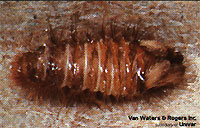

Click to enlarge


Varied Carpet Beetle Larvae (Actual Size 1/4 inch - 8mm)


Pupae are formed in the last larval exoskeleton, and take 10 to 13 days to develop into adults.

RECOMMENDED CONTROL MEASURES:

INSPECTION:

The first step in carpet beetle elimination is a thorough inspection of the entire structure.

Carpet beetle larvae prefer to feed in dark, undisturbed, protected places.

Before the infestation is discovered, the active forms (larvae and adults) may have distributed themselves in such places as the lint collected behind baseboards, in air ducts, in the stuffing of furniture and in the bristles of old paint brushes. From these unsuspected locations, carpet beetles may continue to re-infest valued woolens for long periods of time.

Check under baseboards, in and under upholstered furniture, piano felts, air ducts, stuffed animal trophies, stored cereals, bird nests under eaves, , wasp nests in attics, dead birds or rodents in wall voids, woolens, clothes closets, furs, etc. Black carpet beetles favor animal nests such as that of birds and rodents and can be a source of infestation in the winter when the first sign of cold weather forces the beetles indoors. Location and removal of such nests before winter can also prevent infestation.

Often the cast skins are more abundant than the larvae. Adult beetles flying around windows may help in locating the infestation.

The list of materials upon which carpet beetles can feed successfully is extensive. It includes such diverse substances as meal and flour, peas and beans, animal dandruff, dead insects, leather, dried meats, silk, powdered milk and dog food as well as the natural food substance of wool, fur, hair and feathers mentioned previously. Eggs, larvae, pupae and adults may be brought into the home in any of these substances.

Since adult beetles feed on pollen and nectar, all cut flowers from the outdoors should be inspected for black carpet beetle presence.

Screens should also be installed around windows and doors should be tightly fitted to prevent adults from entering the structure.

VACUMMING:

Remove debris such as animal hair and lint that serves as a food source for black carpet beetles.

When located, infested articles should be disposed of.

However, if the item is of high value, several options are available. Items such as furs can be placed in cold storage at temperatures around 40oC. Also, some items may be frozen for a week in an effort to kill all beetle larvae.

CHEMICAL TREATMENT:

In the case of a heavy infestation, insecticide treatment may be necessary. Before making insecticide treatments for carpet beetles, the premises should be thoroughly vacuumed.

A residual Insecticide spray that is registered for control of carpet beetles is DEMAND CS

Indoor spot or surface treatment with insecticides can provide effective control of carpet beetles, although more than one application may be necessary.


DEMAND SC

Use one gallon of finished product per 1,000 sq. ft. to allow for proper penetration.
Retreat at least two more times, at intervals of 3 weeks.
When spraying rugs or area rugs it would be advisable to spray underneath the underside of the rugs a couple feet or the entire underside.

Clothes should not be sprayed directly.

When spraying or dusting rugs, closet areas, and storage areas, be sure to treat all known or suspected feeding and hiding places. Carpet beetles leaving the infested products will contact the sprayed surfaces and die.


Cracks and crevices can be treated with a dust such as Delta Dust or

Perma Dust aerosol.


perma dust PERMA-DUST a residual aerosol ,with a crack and crevice tip , sprayed in the cracks and crevices, to kill the adult beetles .
You will need 2-4 treatments spaced about 3 weeks apart, due to the nature of their cycles.
DeltaDust has a residual of up to 8 months when left undisturbed.

May be applied using a hand duster or electric dusters.

Bulb Duster

Rubber bulb duster, holds 4 oz.of dry product.

Crusade Duster

Professionally preferred; crack and crevice with extension.

Delta Dust and Perma Dust may also be applied at the edge of carpeting near the baseboards in infested rooms.

Spot treatment of rugs may be made with residual sprays such as Demand SC

Residual insecticides in the emulsifiable concentrates such as Demand SC are the best formulations for treatment of carpets and rugs.


REMEMBER:

  • Although larva and adults may be easily killed, eggs and pupa are not, a complete vacuuming is important.


  • Vacuuming may be used to remove debris such as animal hair and lint that serves as a food source for black carpet beetles.


  • Do not use any insecticide on surfaces where food is eaten, prepared, or stored, or on food itself.


Aerosols Baits for Insects Mole Traps Yellow Jackets
Delta Dust Crusade Duster Fly Control Ants
Air Devil Aerosol Rodent Baits Termite Control Products Black Widow Spider
Aerosol Dispenser Rodent Trapping Rodent Traps Boxelder Bug
Rat and Mice Poison Cockroaches Brown Recluse Spider Lady Bugs
Squirrels Cockroach Control Kit Protecta Bait Stations Cluster Flies
Insecticide Concentrates, Granules, IGR'S Mole Control Timbor Clover Mites
Live Animal Traps Maxforce Roach Bait Pyrethrum /Pyrethrin Products Earwigs
Raccoon Traps MaxForce Fly Bait Konk Too Theophostic Prayer Ministry
T Rex Rat Snap Traps Multiple Mice Traps Mice and Rat Snap Traps Fire Ants
Elijah House Vector Fruit Fly Trap Pest Control Information Groundhogs
Groundhogs Mosquitoes Honey Bees Drain Flies
Opposums Drain Flies Pantry Pest Trap Silverfish
Silverfish Christian Counseling Mice Stinging Insects
Firebrats LadyBugs Scorpion Termite Control
Termites and Termite Bait Fruit Fly /Flies Black Widow Spiders Killing Ants