

Grain Beetles -Saw-Tooth Beetles
Identificaton
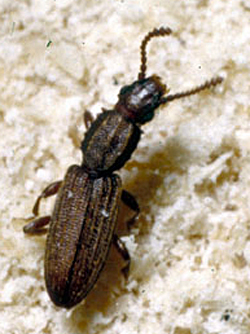
The saw-toothed grain beetle and the merchant grain beetle are slender, flat, brown beetles that are about 1/10 inch long. Both saw-tooth and merchant grain beetles are similar in appearance, with six saw-like tooth projections on each side of the thorax (section between head and abdomen).
The saw-toothed grain beetle has smaller eyes than the merchant grain beetle and a much larger area just behind the eyes.
Saw-Tooth Beetle Habits
The saw tooth beetle is found in warmer climates and does not fly. The merchant grain beetle flies.
In both larval and adult stages, Sawtooth Beetles feed on all food of plant origin, especially grain and grain products like flours, meals, cereals, dried meats, breakfast foods, stock and poultry feeds, coconut, nut meats, candies, and dried fruit; it is not uncommon to find these beetles infesting pet food, bird seed, and rodent bait.
They are small enough to easily penetrate tiny cracks and crevices in packages food products.
Saw-Tooth Biology
The adult Saw-Tooth beetles live an average of 6 to 10 months, but some individuals may live as long as 3 years.
The female beetle drops her eggs loosely among the foodstuffs or tucks them away in a crevice in a kernel of grain.
Eggs are laid either in singles or in small masses in crevices in the food supply or may be laid freely in items such as flour or cereal.
When the small, slender and white eggs hatch, the emerging larvae crawl and feed on the food stuff.
The larva nibble on finely divided food particles, it cannot feed on large particles such as whole grains.
They become full grown in about 2 weeks during summer weather and then construct delicate cocoon-like coverings by joining small grains or fragments of foodstuffs with a sticky secretion.
Within this cell, the larva changes to the pupal stage. Development from egg to adult may take from 3 to 4weeks in summer.
Control Treatment Plans-How to Get Rid Of Saw-Tooth Beetles
Inspect and Discard: First investigate the infested items and discard them. Pay special attention to grains and grain products like cereals. Don't forget nuts, dried fruit, macaroni, chocolate and similar products. The larvae feeds on the smaller grained products; food particles that have been divided. They can not nibble and feed on whole grains. These beetles may be found with other beetles that break down the whole grains.
After inspection, if product like some chocolate or a cereal passes inspection, place it in an air-tight container if possible.If an item passes inspection, it is a good idea to seal it up in an air-tight container.
Clean and Vacuum: Another non-chemical method in Sawtooth Beetle treatments is to clean and vacuum. Vacuum and clean shelves thoroughly. Pay attention to cracks and crevices and under your shelves, and around wire shelving.
Use Pheromone Traps: These traps have a sex pheromone in order to catch and trap male cigarette beetles. They will also attract male moths. Place only a couple of traps in the kitchen or pantry. We recommend either the Invite Multi Lure.
Use Insecticide Aerosols: This is to be done after cleaning and before placing the foodstuffs back on the shelves. They will help prevent furture infestations in the cracks and crevices. For larger areas, use insecticide concentrations, such as D-Fense SC. Top recommended aerosols are Alpine PT or Phantom Aerosols.
Guidelines To Get Rid of Sawtooth Beetles.
*Sawtoothed grain beetle image-. Clemson University - USDA Cooperative Extension Slide Series. Bugwood.org.
 All Pantry Control Products