

Mediterranean Meal Moths
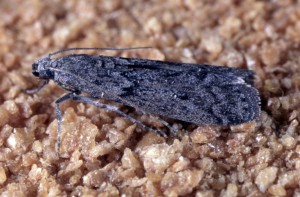
The Mediterranean Flour Moth is somewhat larger than the Indian Meal Moth
Development and damage are similar to the Indian meal moth, except the larvae live and feed in small silken tubes they spin. Although flour is the favorite food, grains, bran, breakfast foods and pollen in beehives are also attacked. The life cycle takes about 10 weeks. The webbing and matting of the larvae often cause the greatest amount of damage by this insect, whether it is contaminating foods in the home or clogging industrial machinery.
Get Rid Of Pantry Indian Meal Moths
Mediterranean Meal Moth Identification
- The adult moth is a pale-gray color and from one-forth to one-half inch long, with a wingspread of slightly less than one inch.
- The wings are marked with two indistinct, black zigzag lines.
- The hind wings are a dirty white.
- This moth is easily recognized by its characteristic pose when resting. When at rest, the moth extends the forelegs, which raises the head and gives the body a sloping appearance. None of the other house moths have this characteristic pose.
Life Cycle and Habits Of Mediterranean Meal Moths
The female moth lays from 116 to 678 small white eggs in accumulations of flour, meal, waste grain, nuts, chocolate, beans, dried fruits and other food sources.
Commonly, the eggs are attached to the food. Within a few days (three days at eighty to ninety degrees F) the eggs hatch into small whitish or pinkish larvae, with a very hard and dark colored head and small black spots on the body that immediately begin to spin silken tubes.
The larvae remain within the tubes until fully mature, which takes approximately forty days.When fully grown, the larvae will leave the immediate area where they were feeding and wander about in search of a location to spin silken cocoons. Within the cocoons, they transform into reddish-brown pupae.
After eight to twelve days the adult moths emerge from the pupated state.
During very warm weather, the Mediterranean flour moth may complete its life cycle (egg to adult) in five to seven weeks.
How to Detect An Infestation In Your Kitchen or Pantry
Besides identifying this store product pest by its characteristic pose of resting, you can detect webbing in your foodstuffs. As with the Indian Meal Moth, look inside the food containers, many times you will see their lavae. Their larvae is a pink-white color or yellow-white in color. The larvae head is reddish.The larvae will cause the food to clump together, which is easier to see with the naked eye.
Mediterranean Meal Moth Control Treatment Plans
Inspect: The first step for Mediterranean Meal Moth control is to find the source of the infestation. This is the hardest and mostly lengthly step. Inspect all the products in your pantry such as, flour, meal, seeds, nuts, chocolate, beans, dried fruits, dried pet food, cereals, and other food sources. Check each package, beginning with the older materials and packages that were bought in bulk containers. Don't forget to check seasonings, especially the long forgotten seasonings in the back of your cupboards.
Discard: After finding the infested items, discard them. If in doubt about a food item, place it in a Ziploc bag for 30 days and watch for any infestation signs.
Clean and Vacuum: Thoroughly clean shelves in cabinest and shelves. Clean all cracks and crevices. All it takes is a few crumbs or particles of food for a Mediterrean Meal Moth to survive.
Use Pheromone Traps: These traps have a sex pheromone in order to catch and trap male moths. These traps are usually made of cardboard with a sticky interior. Either the pheromone is part of the glue substance or it is in a separate packet. Not only are pheromone traps useful for trapping the Mediterranean Meal male moths and preventing further reproduction, but they are useful monitoring tools.
 All Pantry Control Products