

Flour Beetles
 Flour Beetles not only can be found in flour products, but also in such food items such as, stored cereals, nuts, spices, coffee, dried fruits and cocoa. Flour beetles do not feed on whole grain kernels such as other pantry pests like Indian Meal Moths and Drugstore Beetles. Flour Beetles are scavengers, feeding on the grain only after the seed coat has been broken. The female flour beetle places eggs directly on flour, cereals, dry pet food and similar items.
Both of these flour beetles are considered a stored product pest that can be found in residential and commercial settings. They can cause considerable financial losses in food processing centers, food mills and commercial storage areas. The red flour beetle, confused flour beetle, sawtooth grain beetle, and Indian Meal Moth are the most predominant stored product pests in homes and gocery stores.
Control Treatment Plans-How to Get Rid Of Flour Beetles
Inspect and Discard: First inspect the infested items and discard them. Pay particular attention to the dry grains. Every item that the categories of flours, milled grains, powdered milks, cocoa, meals, etc needs to be inspected one by one. If an item passes inspection, ti is a good idea to seal it up in an air-tight container.
Clean and Vacuum: Vacuum and clean shelves thoroughly. Pay attention to cracks and crevices and under your shelves, and around wire shelving. It doesn't take a lot of food for these Flour Beetles to survive.
Use Pheromone Traps: These traps have a sex pheromone in order to catch and trap male flour beetles. They will also attract male moths. Place only a couple of traps in the kitchen or pantry. We recommend either the Invite Multi Lure or Pantry Patrol.
Use Insecticide Aerosols: This is to be done after cleaning and before placing the foodstuffs back on the shelves. They will help prevent furture infestations in the cracks and crevices. Top recommended aerosols are Alpine PT or Phantom Aerosols.
Guidelines To Get Rid of Flour Beetles.
Confused and Red Flour Beetle Identification
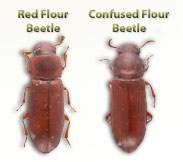
The confused flour beetle and the red flour beetle are very similar in appearance and can be most easily distinguished by examining the antennae. The antennae of the red flour beetle ends abruptly in a distinct , three-segmented club. The while confused flour beetle's antennae gradually enlarges towards the tip, ending in a four-segmented club.
Red Flour Beetle
The red flour beetle is primarily a pest in southern states and is a good flier.
Confused Flour Beetle
The confused flour beetle is primarily a pest in northern states. The adults do not fly.
Adult beetles of these two flour beetles have shiny, reddish brown bodies that are about 1/7 inch long, flattened, and oval.
Life Cycle and Habits Of Flour Beetles
The biologies of these two flour beetles are very similar; their average life span is about 1 year, but some have been known to live almost 4 years.
As flies and fleas go through a complete metamorphosis, flour beetles go through the stages of this metamorphosis from a egg stage , to larvae stage , then a pupae stage, and finally emerges as an adult beetle.
The females lay their small, white eggs loosely in flour or other food material. The eggs, which are coated with a sticky secretion, become covered with flour or meal and readily adhere to the sides of sacks, boxes, and other containers. These eggs are hard to see.
The females lay a couple of eggs each day in the food that she is eating and has the ability to lay 300-400 eggs during her lifetime. The egg laying can last several months.
They hatch into small worm-like larvae that are slender, cylindrical in appearance. When fully grown, the larva is3/16 inch long and white, tinged with yellow. At this stage, it transforms into a small pupa. At first white, the pupa gradually changes to yellow and then brown, and shortly afterward transforms into a beetle. In summer, the period from egg to adult averages about 6 weeks.
The small size of the confused flour beetle enables it to work its way inside many sealed containers. These beetles have a very wide food range including cereals, grains, spices, grain products, shelled nuts, dried fruit, chocolate, drugs, peas, beans and other similar materials.
How to Detect An Flour Beetle Infestation
Even though these stored product pests prefer to feed on flour products, they will attack a broad range of food items. Inspection is a must. Look in nearby food products such as pet food, birdseed, cake mixes, bisquit mixes, muffin mixes, spices, powdered milk, nutmeats, cornmeal, crackers, insect and rodent baits. Use a magnifying glass and flashlight to help with inspection.
 All Pantry Control Products