

Cigarette Beetles
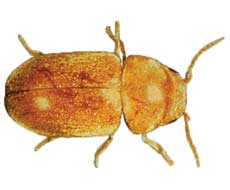 Cigarette beetles and the drugstore beetle closely resemble
one another, but the cigarette beetle is the more common of
the two beetles. The Cigarette beetle has a "hump-backed" appearance. Both of these pantry beetles are external feeders. As an external feeder, they feed on the outside of the grain. They may also devour the inside, after chewing the outer coating of the grain.
Cigarette beetles and the drugstore beetle closely resemble
one another, but the cigarette beetle is the more common of
the two beetles. The Cigarette beetle has a "hump-backed" appearance. Both of these pantry beetles are external feeders. As an external feeder, they feed on the outside of the grain. They may also devour the inside, after chewing the outer coating of the grain.
Cigarette Beetle Damage
 Cigarette Beetles are a serious pest in stored tobacco industry. This includes cigars and chewing tobacco as well as cigarettes. Cigarette Beetles will also feed on books and book bindings. Cigarette Beetles will feed on foods and seasonings such as cottonseed meal, pepper, paprika, chili, dried fish, ginger, dates, raisins, pasta, and seeds. They will be a pest to dry flower arrangements, wreathes and papier-mâché. Cigarette Beetles will even feed of pyrethrum; the same active ingredient found in many insect baits and insecticides. These beetles will also do damage to furniture stuffing.
Control Treatment Plans-How to Get Rid Of Cigarette Beetles
Inspect and Discard: First investigate the infested items and discard them. Every item from the categories listed above needs to be checked. If an item passes inspection, it is a good idea to seal it up in an air-tight container. Cigarette Beetles migrate to new materials quickly, so a complete inspection is critical. Don't forget to check the dry flower arrangements and any art work that has dried natural foods or plants.
Clean and Vacuum: Vacuum and clean shelves thoroughly. Pay attention to cracks and crevices and under your shelves, and around wire shelving.
Use Pheromone Traps: These traps have a sex pheromone in order to catch and trap male cigarette beetles. They will also attract male moths. Place only a couple of traps in the kitchen or pantry. We recommend either the Invite Multi Lure or Pantry Patrol.
Use Insecticide Aerosols: This is to be done after cleaning and before placing the foodstuffs back on the shelves. They will help prevent furture infestations in the cracks and crevices. For larger areas, use insecticide concentrations, such as D-Fense SC. Top recommended aerosols are Alpine PT or Phantom Aerosols.
Guidelines To Get Rid of Cigarette Beetles.
Cigarette Beetle Identification

The Cigarette beetles are about 1/8 inch long, cylindrical, and uniformly light brown. Their mature larvae is white. Its head is bent downward giving it a characteristic hump back appearance. The wing covers of the drugstore beetle have longitudinal grooves while those of the cigarette beetle are smooth. Also, the body hairs of the cigarette beetles are considerably longer, giving it a more "fuzzy" appearance.
Life Cycle and Habits
Cigarette Beetles are good fliers. They are most active during the early evening hours and cloudy days, unless temperatures are below 65 degrees F. During the day they hide in dark places. These beetles are attracted to light. Even though, they may fly into your homes, their primary way of transportation and spreading is through infested materials.
The female Cigarette Beetle lays an average of 30 eggs over a period of 3 weeks in newly harvested tobacco, susceptible food items, dried plants, pet food, etc. The eggs hatch out in a week to two weeks and the new larvae will begin to feed on food stuffs or other items that attracts Cigarette Beetle larvae. The full grown larvae will go into the pupae stage and pupate in silk like cocoons covered with materials they have infested.
The life cycle of the Cigarette Beetle (egg to egg) is generally 30-90 days. This life cycle depends on the temperature and available food source. There may be 3-6 generations per year. Adult Cigarette Beetles live from 23-28 days.
How to Detect A Cigarette Beetle Infestation
Even though these stored product pests prefer to feed on tobacco products, they will attack a broad range of food items. Inspection is a must. Look in nearby food products such as pet food, seeds and seasonings, dried fruits, cottonseed meal, pepper, paprika, chili dried fish, ginger, dates, raisins, pasta, and seeds, dry flower arrangements, wreathes and papier-mâché, dust and baits with pyrethrins, and rodent baits. Use a magnifying glass and flashlight to help with inspection.
 All Pantry Control Products